
What Age Do Puppies Sleep Through the Night?
What Age Do Puppies Sleep Through the Night?
Somewhere in that fog, around 2 a.m., with a warm puppy finally snoring on your shoulder, you find yourself typing what age do puppies sleep through the night into your phone. Plenty of new puppy parents ask the same thing, usually after a week of broken sleep and a hallway that smells faintly of wee.
The short answer is that most puppies can manage about six to eight hours without a potty break somewhere between roughly 3 and 6 months old. Many get there closer to four months. Some take until they are half a year old or a little beyond. Very young puppies often still need one trip outside in the middle of the night, and that is normal, not a sign that something has gone wrong or that you chose the wrong puppy.
What sleeping through the night actually means
When people say a puppy sleeps through the night, they usually mean a stretch of six to eight hours with no potty trip and no crying. That is a long time for a small animal with a small bladder. A young puppy's sleep also comes in short bursts, so a pup who has been asleep for ninety minutes may wake simply because that is their rhythm, not because something is wrong.
Many owners ask how long until puppy sleeps through the night, and the honest reply is a few months, with plenty of wiggle room. Keep the goal in perspective. A puppy who wakes once at 3 a.m. and settles back down within a few minutes is doing well. A puppy who wakes four times and wants a long play session is probably still a baby, and that is fine too.
Why the age range is so wide
Bladder control is one piece of the puzzle, but not the whole picture. Size and breed play a part, since small breeds tend to have smaller bladders and may need more trips. Your puppy's daytime routine matters too. A pup who gets a good last potty trip, a calm evening and a quiet sleeping spot usually does better than one who runs wild until bedtime and is then surprised by a full bladder.
Your neighbor's puppy may have slept through at ten weeks while yours is still waking at four months, and that does not mean anything is wrong. So, when do puppies sleep through the night in your home? Usually it depends on the puppy in front of you. Health and temperament matter as well. A puppy with an upset tummy, a urinary issue or a sudden change in appetite may need a vet check, and night waking can be an early clue. If you want more detail on the stages of learning to hold it, our potty training timeline walks through what usually comes first.
What to expect by age
These are the typical patterns we see in puppies who are healthy and settling in. Use them as a loose guide, and tell your vet how your puppy is actually doing.
| Age | Typical night pattern | What tends to help |
|---|---|---|
| 8 to 10 weeks | One or two potty trips, plus some waking for comfort | A last potty trip before bed and a sleep spot close to you |
| 10 to 12 weeks | Stretches may get longer, but nights vary a lot | A consistent bedtime and a calm, dim routine |
| 3 to 4 months | Some nights are full, others still need a trip | A steady routine and a predictable first wake-up time |
| 4 to 6 months | Many settle into longer stretches, and some still wake | Patience, plus a vet check if waking gets worse |
8 to 10 weeks
This is the newborn stage in dog terms. Your puppy has just left the litter, and the house is full of new sounds. Expect at least one middle-of-the-night trip, sometimes two. Keep those trips quiet and businesslike. Lights low, no chatting, no play, then straight back to bed.
10 to 12 weeks
You may start to see the first real stretches of sleep. One morning you wake up and realize the puppy has been quiet since midnight, and you feel like a genius for about five minutes. Then the next night brings a 2 a.m. wail. That roller coaster is normal. Keep the routine steady and let the good nights come as they come.
3 to 4 months
Many puppies get noticeably better around here, though not evenly. Growth spurts, new teeth, a busy day at the park or a change in your schedule can knock sleep off track for a few nights. If your puppy is generally improving, a rough week is usually just a bump.
4 to 6 months
By this point a lot of puppies settle into a longer night, and you may find yourself pleasantly surprised. Some still wake, especially if they are teething, excited about something or living in a noisy home. Be honest with yourself about whether the waking is a potty need, a habit or a real health concern, and check with your vet if you are unsure.
Building a bedtime routine that helps
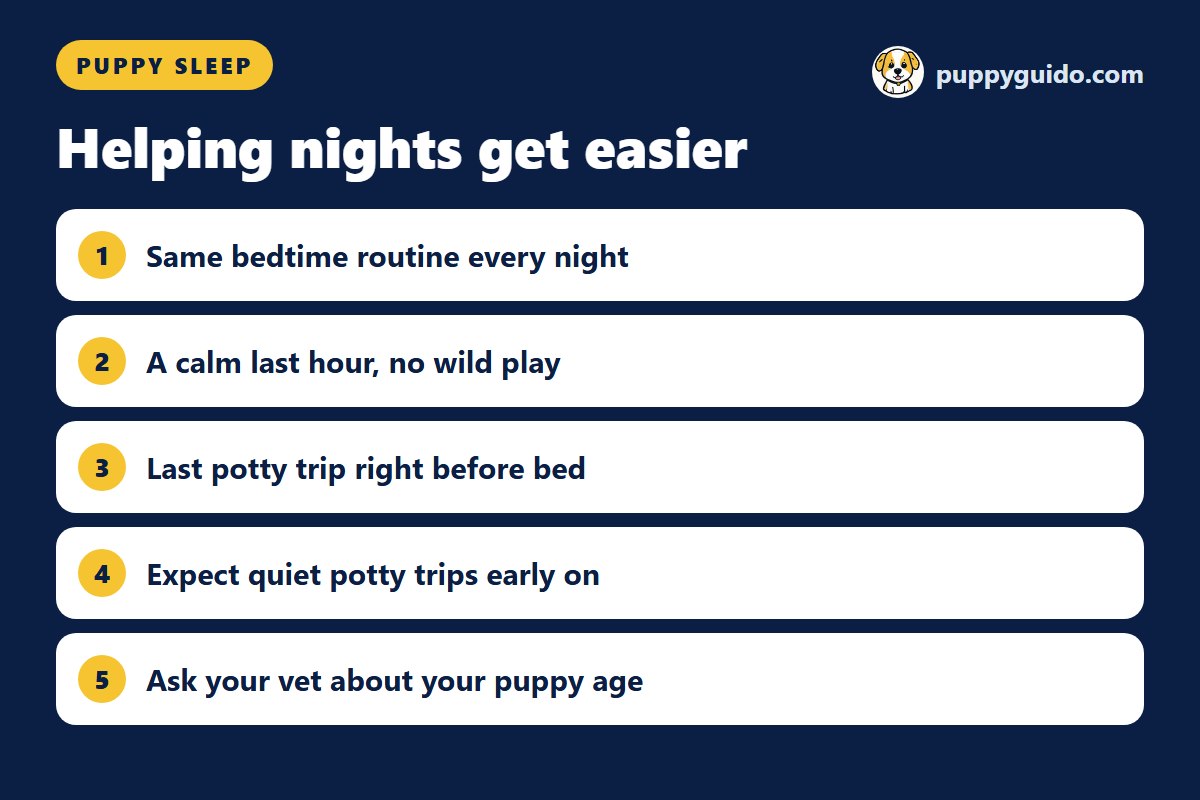
A bedtime routine does not need to be fancy. It needs to be the same most nights, so your puppy learns what comes next. Here is a simple version that many new owners find workable.
- Offer the last meal a few hours before bed. Keep water available, but do not let your puppy gulp a big bowl right before lights out.
- Take a final potty trip outside, even if they just went. Keep it dull: same spot, no games, and a quiet word of praise when they go.
- Play calmly for about ten minutes. You want a tired puppy, not an overexcited one. A gentle sniffing game or a chew works well.
- Dim the lights, lower your voice and move to the sleep spot.
- Settle them in with a safe chew or a worn T-shirt that smells like you, then leave the room quietly.
- If they wake, pause before reacting and ask whether they need a potty trip first.
Notice what is missing from that list. Nothing is a punishment, and nothing requires you to be a perfect parent at 2 a.m. You are simply making the night predictable.
Night potty trips without the drama
Most middle-of-the-night potty trips follow the same pattern, which is why they are worth practicing. Take your puppy to the same spot. Keep the lights dim and your voice low. Let them do their business, offer quiet praise, and head straight back to bed. If you turn the trip into a play session, your puppy learns that waking up is the fun part, and you will be back out there the next night.
A regular daytime schedule helps the nights too, because the bladder learns when to expect a break. Our potty schedule by age is a good place to match your daytime rhythm to what your puppy can realistically hold.
Accidents happen. If your puppy has a wee on the rug at 4 a.m., clean it up calmly, without scolding, and look at what may have led to it. Was the last trip too early? Did they drink a lot right before bed? Small adjustments usually work better than any big change.
Setting up the sleeping space
The sleep spot does a lot of quiet work. Many people use a crate, and a crate can become a cozy sleep space when it is introduced slowly. If you are not sure how to start, our guide on crate training a puppy covers the gentle steps, from the first sniff to the first full night.
Put the sleep spot in the same room as you, at least at first. A puppy who can hear you breathing usually settles faster than one stuck in a distant hallway. Add a soft bed, a blanket that smells like home, and a water bowl placed where it will not spill onto the bedding. Keep the area away from drafts and anything the puppy could chew through or tangle in. Your first night at home may feel like a test, and our piece on the first night at home covers what to expect in those early hours.
When the night goes sideways
Some nights will go badly. Your puppy will cry, you will check everything twice, and you will eventually sit on the kitchen floor wondering what you signed up for. That feeling is common. Crying in the early nights is often about missing the litter, unfamiliar smells or a real need for a potty trip. Our article on puppy crying at night goes through the common causes and calm responses.
Try to respond the same way each time. Check for a potty need, offer a quiet word and a gentle hand, and then return to the routine. If you comfort every single whimper with a long cuddle and a trip downstairs to the couch, the night becomes a negotiation, and your puppy learns that noise gets results. A calm, boring response is kind and effective at the same time.
When to ask a professional
Most night waking is normal, but some signs are worth a call. Speak with your veterinarian if your puppy seems unable to settle for long periods, cries as if in pain, strains to pee, has blood in the urine, drinks far more than usual, or seems unwell during the day. Your vet can also give you age-specific guidance, check growth and general health, and tell you what is typical for your puppy's breed and size.
If your puppy seems unwell or cannot pee, contact your vet promptly rather than waiting for morning.
Bring notes to that appointment. Write down when your puppy wakes, what time you feed, and what the potty trips look like. That information makes a short visit far more useful.
If you want a simple plan for these first months, the Get the free New Puppy Survival Guide pulls the routines in this article into one place, so you have something to check at 2 a.m. when your brain is running on fumes.
Frequently asked questions
Is it normal for a puppy to wake up at night?
Yes, very normal. Young puppies have small bladders, short sleep cycles and a lot of energy, so night waking is common through the early months. Many puppies wake once or twice a night for weeks before the pattern settles. If your puppy wakes often, seems distressed, or appears unwell, speak with your veterinarian.
How long does it take to potty train a puppy at night?
There is no fixed timeline, and many puppies need several months of consistent night routines. Night training often follows daytime training, because the bladder needs time to mature. Keep night trips calm and boring, and expect setbacks during growth spurts, illness or a change in routine.
Should I wake my puppy up to pee at night?
Usually no, unless your vet or breeder has suggested it for a specific reason. Most puppies wake themselves when they need to go. Make sure the last trip before bed is thorough, and if your puppy sleeps soundly for a long stretch, let them rest. Ask your vet if you are unsure what suits your puppy.
Can my puppy sleep in my bed?
That is a personal choice, and plenty of families do it. A puppy who shares your bed may be harder to move to their own space later, and may wake you with every small noise. If you want them to sleep elsewhere eventually, starting with a bed or crate nearby can make the change smoother.
Why does my puppy cry at night?
Crying is common in the first nights because your puppy has left their littermates and everything smells unfamiliar. It can also mean a need for a potty trip, hunger, or simply wanting company. Stay calm, check for a potty need first, and offer quiet comfort. If the crying is constant or you feel worried, call your vet.
What time should a puppy go to bed?
Pick a consistent bedtime that fits your household, often in the early evening for young puppies who wake early. Consistency matters more than the exact hour. Aim for a predictable routine that ends with a last potty trip and a settle in the sleep space, and keep those same steps each night.
Disclaimer. PuppyGuido provides general educational information and does not replace advice from a qualified veterinarian or professional trainer.
Keep reading
How to Choose the Right Crate Size for Your Puppy
A crate that fits today, still works in six months, and stays clean enough to be her safe place. Here is how to get there.
Read article
Puppy Nap and Sleep Schedule: What Is Normal and How to Plan Your Day
What is normal puppy sleep, and how to plan naps and bedtime without a rigid clock.
Read article
Crate Training a Puppy: A Step-by-Step Guide
Crate training a puppy step by step: choose the right crate, make it a calm place, build up crate time by age and handle crying at night kindly.
Read article