
When Does Puppy Biting Stop? What Is Normal
When Does Puppy Biting Stop? What Is Normal
It is 6:40 on a Saturday morning, and your eight-week-old puppy has just clamped onto your sleeve, then your ankle, then the hem of your pajama pants. You are tired, a little bruised, and wondering when puppy biting stops. The honest short answer is that for most puppies, the worst of it eases somewhere between 4 and 6 months old. Some ease off sooner and some take longer, and nobody can promise you an exact date, because every puppy is a little different.
The good news is that biting is normal puppy behavior, not a sign you got the wrong dog. Puppies explore with their mouths, they are teething, and they usually learn how hard is too hard from their littermates. Your job is to teach those same lessons in a kinder way. You will not skip this phase entirely, but with a steady routine you can shorten it a lot.
Why puppies bite in the first place
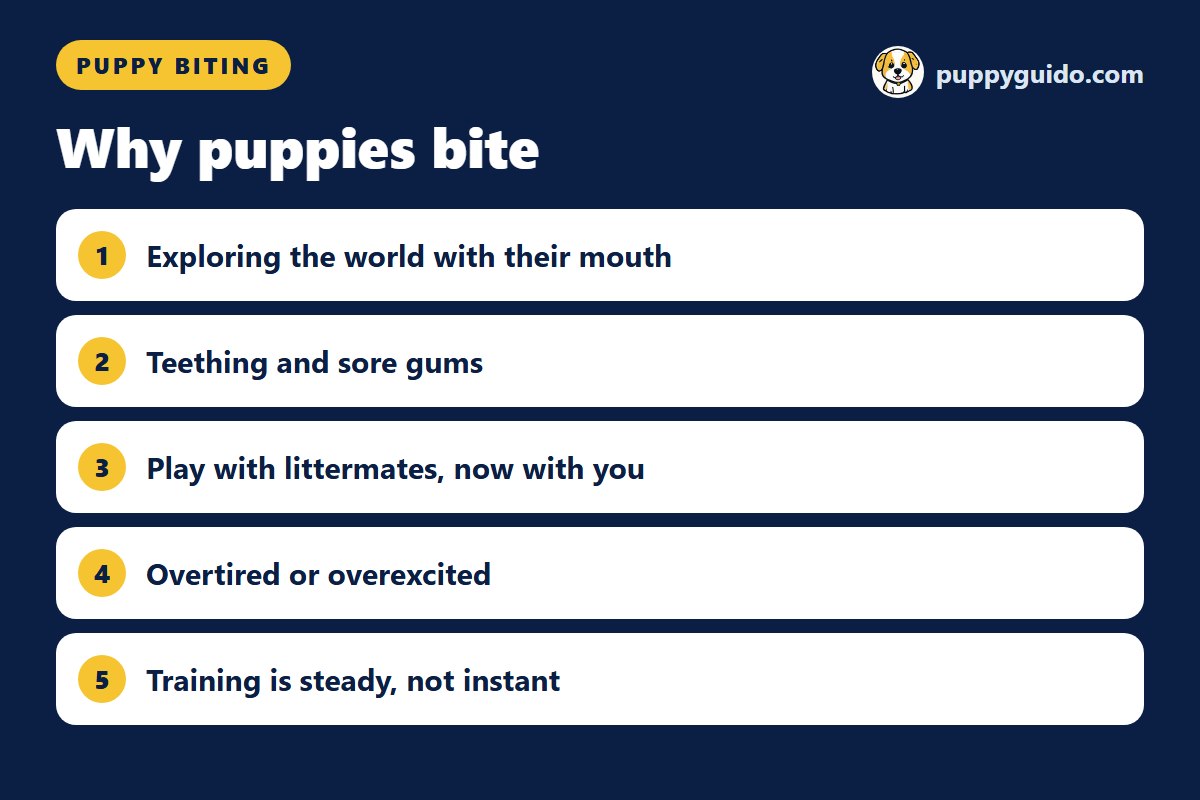
Puppies use their mouths the way we use our hands. They pick things up, test textures, and figure out what is edible and what is not. Play biting is also a big part of how young dogs practice social skills. A litter of puppies wrestles, nips, yelps, and rolls over, and that rough play teaches them that teeth can make the game stop.
Teething adds another layer. Most puppies go through the teething stage roughly between 3 and 6 months, when baby teeth fall out and adult teeth push through. Gums feel sore and itchy, and chewing on something firm brings relief. That is why your hand, your shoelace, and your favorite slipper all look so appealing to a teething pup.
Biting also works as attention. If a puppy finds that a nip makes you jump, squeal, or laugh, it has learned a very rewarding game. The puppy is not being naughty. It is simply doing what gets results, which is why changing how you respond makes such a difference.
How long puppy biting usually lasts
If you are wondering how long puppy biting lasts, the answer depends on your puppy's age, personality, and how consistently the household responds. The table below gives a rough picture of what many puppies go through. Think of it as a map, not a schedule.
| Age | What the biting often looks like | What tends to help |
|---|---|---|
| 8 to 10 weeks | Quick, needle-sharp nips during play, grabbing hands and clothing | Short play bursts, toys within reach, pausing when teeth touch skin |
| 10 to 12 weeks | Longer play sessions, chasing, pouncing on feet and ankles | Planned play with breaks, redirecting to toys, more sleep |
| 3 to 4 months | Teething starts, chewing gets stronger, biting gets worse when overtired | Frozen chew toys, quiet time, steady redirection every day |
| 4 to 6 months | Adult teeth settle, biting often softer and less frequent | Keep the routine going and reward gentle mouths |
8 to 10 weeks
This is when the needle teeth show up, and they are sharp enough to make you flinch. Most puppies at this age are also just getting used to people, so play can get frantic fast. Keep sessions short, have a toy in your hand at all times, and expect plenty of nipping. It feels relentless, but it is also the stage where your puppy is learning the most.
10 to 12 weeks
Play gets longer and more physical. Your puppy may chase your feet, grab your pants, and come back for more even after you have stopped. This is often when owners feel the most overwhelmed. A calm routine helps: play, then rest, then play again. Puppies that get enough sleep are usually easier to handle than the ones that never stop.
3 to 4 months
Teething tends to show up now, and it can make the biting feel worse even though your training is working. Chewing becomes more of a need than a game. If you have been wondering whether you are doing something wrong, this stage often explains the spike. Keep offering appropriate chews and keep redirecting.
4 to 6 months
For many puppies, this is where things start to ease. Adult teeth have mostly come in, the mouthy phase starts to wind down, and your puppy may be more able to settle. Some dogs still mouth during play at this age, and some need more time, so please do not panic if the change is slow.
Why the biting suddenly gets worse
Maybe you are asking yourself why your puppy is biting all of a sudden. One day the biting was manageable, and the next morning every hand looks like a target. Sudden changes often have a simple explanation. Teething is the most common one, and it can come in waves. Overtiredness is another. A puppy that has been awake too long, or that had a busy visit, can turn into a tiny shark within minutes.
New people and new places can also trigger extra biting. A houseful of guests, a trip to the park, or a fresh pile of laundry on the floor can all overexcite a puppy. We have seen a calm pup become a chewing machine after a birthday party, mostly because it was overstimulated, not because anything had gone wrong at home. Look back over the last day or two for clues, and you will often spot the trigger.
Sudden changes can occasionally point to something physical, such as discomfort in the mouth or a general feeling of being unwell. If the change comes with a drop in appetite, bleeding gums, limping, or unusual behavior, it is worth a call to your veterinarian rather than waiting it out.
What is normal and what is not
Before you worry, it helps to know what is normal when it comes to puppy biting. Most of the time, mouthing, nipping, and chewing on hands, sleeves, and feet are typical for a young dog. Puppies also tend to be mouthy during play and when they get excited, and it is common for them to target ankles, heels, and feet.
Here is a quick way to sort the two:
- Usually normal: soft mouthing during play, nipping when excited, grabbing clothing, chewing on shoes and hands, and mouthing when overtired.
- Worth talking about with a vet or a qualified positive reinforcement trainer: bites that break skin again and again, growling with a stiff body that does not ease, biting from fear that gets worse over time, or biting that comes with other sudden changes.
If your puppy's gums bleed, if it stops eating, or if it seems in pain, contact your veterinarian before assuming the cause is behavior.
Most puppies fall comfortably in the first group. If your puppy does, you are dealing with a normal phase that calls for patience and a good plan.
The pause, redirect, reward routine
This is the heart of the process. Each time your puppy bites, you respond the same way, calmly and consistently. The routine works because it removes the fun of the bite and makes the chew toy the better option. Our full guide on how to stop puppy biting goes deeper, but here is the core sequence:
- Pause. Go still as soon as teeth touch skin. Keep your hands soft and out of the puppy's grip, and do not pull away quickly, since that can invite a chase.
- Redirect. Offer a toy the puppy is allowed to chew. Wiggle it, make it move, and say a short cue word you use every time.
- Reward. When the puppy takes the toy, praise warmly and give a treat or a short game. You are rewarding the behavior you want, not the bite.
- Reset if needed. If the puppy keeps going, end the game calmly and let it settle for a few minutes. Think of this as a fresh start, not a punishment.
- Repeat. Do the same thing every time, and make sure everyone in the house does too. Consistency is what turns a few weeks of effort into real progress.
At first the routine may feel like you are spending all day redirecting. That is normal. Over time, the puppy learns that a gentle mouth gets play, while a hard bite makes the fun stop, and the number of bites usually drops.
Rest, routine and the bite-prone hours
Overtired puppies bite more, and many owners notice a daily pattern. Late afternoon or the hour after a big outing is often when the teeth come out. Puppies need a lot of sleep, often more than most people expect, and a short nap can change the whole mood of the house.
Try building rest into your day on purpose. After a visit, a walk, or a lively play session, move your puppy to a quiet room or a crate for a settle-down time. If you are still setting up that space, our guide to crate training a puppy covers how to make the crate a calm place to rest rather than a place to fuss over.
We also like to keep an eye on the clock. If the biting always spikes around 5 p.m., plan a calm activity before that time and a sleep right after. Small tweaks like this often do more than another round of redirects.
Management that makes the days easier
Management means setting up your home so your puppy practices gentle play rather than the wrong kind of biting. Think of it as making the right choice the easy choice. Keep a small basket of chew toys in each room you spend time in. Store your slippers, socks, and shoelaces out of reach while your puppy is in its mouthy phase, and offer a teething toy or a chilled washcloth when you see the gnawing start.
Supervision matters too. Use baby gates or a playpen when you cannot watch closely, and give your puppy a quiet space where it can settle. Our puppy essentials list is a helpful starting point if you are still stocking up on chews, toys, and a sturdy playpen.
Keep a few treats in your pocket for the moments you want to reward. A puppy that gets a little praise for resting, sniffing a toy, or sitting quietly will start choosing those behaviors more often. Small, frequent rewards work better than one big reward at the end of a long day.
When to ask a professional
Most puppy biting is a normal phase, but some situations call for extra help. Reach out to your veterinarian if the biting comes with bleeding gums, a change in appetite, pain while chewing, or any sudden shift in energy or behavior. A vet can rule out physical causes and give you guidance that fits your puppy.
A qualified trainer who uses positive reinforcement can help if the biting breaks skin often, if your puppy growls or stiffens when handled, or if the behavior is not improving after several months of consistent work. Ask any trainer how they approach biting, and look for someone who uses rewards and clear routines rather than scolding or punishment.
Every puppy is different. Some are gentle from day one, and others need a longer road. Whatever your puppy's pace, steady, kind responses are the most reliable way to help it grow into a confident, gentle adult dog.
If you want a simple plan for the first weeks at home, Get the free New Puppy Survival Guide.
Related reading: for what teeth are doing and what to chew, see the teething timeline and safe chews, and the development stages guide.
Frequently asked questions
Is it normal for a puppy to bite all the time?
Yes, for most puppies, mouthing and nipping happen a lot in the early weeks, especially during play and when they are tired or excited. Constant biting is common at first and usually softens as your puppy learns, with your help, that hands are not toys. If the biting never seems to let up, or hurts more than you can handle, talk with your veterinarian or a qualified positive reinforcement trainer for a plan.
Why is my puppy biting all of a sudden?
A sudden change often has a simple explanation, such as teething, being overtired, a visitor who got everyone excited, or a burst of energy as your puppy grows. Look back over the last day or two for clues. If the change comes with bleeding gums, a drop in appetite, limping, or unusual behavior, contact your veterinarian, since pain or illness can change how a puppy acts.
How long does puppy biting last?
For many puppies, the hardest stretch falls between about 8 weeks and 4 to 6 months, with the sharpest bites often easing as adult teeth settle. Some puppies stop sooner and some take longer, and a few adolescent dogs still mouth during play. Consistent redirection every day usually makes the change come faster, even though nobody can give you a firm end date.
Should I yell at my puppy when it bites?
Please avoid yelling, grabbing the muzzle, or flicking the puppy's nose. These responses often turn biting into a more exciting game, and they can make a puppy wary of hands. A calm pause, a quick switch to a toy, and praise for gentle play are kinder and tend to work better over time.
When do puppies stop teething?
Most puppies finish losing their baby teeth and getting their adult teeth somewhere around 6 months, so the most uncomfortable chewing phase often happens between about 3 and 6 months. Every puppy runs on a slightly different schedule. If you notice pain while chewing, a tooth that seems stuck, or bleeding, ask your veterinarian to take a look.
How can I stop my puppy biting my children?
Keep children and puppy supervised, and give kids a simple script: stand still, fold your arms, and then trade the puppy a toy. Adults should handle the puppy during rough play, and kids should avoid running or squealing, which invites chasing and nipping. Positive reinforcement works well here, so reward calm moments with praise and a treat from an adult.
Disclaimer. PuppyGuido provides general educational information and does not replace advice from a qualified veterinarian or professional trainer.
Keep reading

Puppy Teething: Timeline, Signs and Safe Things to Chew
When puppies lose baby teeth, what teething looks like, and which chews are safe. A clear timeline for new owners.
Read article
How to Stop Puppy Biting: The Pause, Redirect, Reward Method
Sharp little teeth are normal. A gentle three-step method that works without punishment.
Read articlePuppy Slow Feeder Bowls: Are They Worth It?
A calm, practical look at whether a slow feeder bowl suits your new puppy, and how to use one without the mealtime drama.
Read article