
Puppy Blues: Feeling Regret After Getting a Puppy (and What Helps)

Puppy Blues: Feeling Regret After Getting a Puppy (and What Helps)
Heads up. Some links in this article are affiliate links. If you buy through them we may earn a commission at no extra cost to you. As an Amazon Associate we earn from qualifying purchases.
If you brought home a puppy and feel more exhausted, anxious or tearful than excited, you are not alone, and it does not mean you made a terrible mistake. This pattern is common enough that researchers have studied it and given it a name: the “puppy blues”.
This article explains what puppy blues are, why you can feel overwhelmed after getting a puppy, what usually helps, and when it is worth asking a professional for support.
What are the puppy blues?
Puppy blues describe the stress, worry, frustration or regret some people feel in the first weeks or months after getting a puppy. Researchers compare it to the “baby blues” some new parents go through: you can love the little one and still feel worn out and unsure you are doing it right.
In 2024, a research team at the University of Helsinki published the first questionnaire designed to measure puppy blues (Ståhl and colleagues, npj Mental Health Research). They built it from owners' own descriptions, then tested it on 1,801 dog owners in Finland, 92% of them women. The study identified three parts of the experience:
- Frustration: feeling irritated by the biting, accidents or constant demands.
- Anxiety: worrying that you are doing something wrong or that something bad will happen.
- Weariness: being tired in a way that makes everything feel heavier.
The researchers also asked owners of 1–2-year-old dogs about both the puppy period and the present. Scores for the present were significantly lower than for puppyhood, which fits the idea that puppy blues are temporary. They also noticed that people tend to remember the puppy period more positively as time passes.
In media interviews about the study, the researchers said that just under half of the owners surveyed reported significant negative experiences during puppyhood, and only about one in ten reported the most severe strain. Those percentages come from the researchers' public comments, not from the paper's abstract, so treat them as approximate. Also keep in mind that the participants were Finnish dog owners and mostly women, so the numbers may not match every country.
Why can you feel overwhelmed after getting a puppy?
A puppy changes your day almost overnight. The things that most often wear people down are simple and very practical:
- Broken sleep. Young puppies cannot hold their bladder all night, so night-time trips outside and crying are normal. See what to check when a puppy cries at night.
- Constant supervision. A puppy cannot be left to roam, so you rarely get a true break.
- Biting and chewing. Sharp teeth on hands and ankles are normal, but painful. Our guide to stopping puppy biting covers a calm method.
- Potty accidents. Progress is rarely a straight line. A simple daily potty schedule helps.
- Too much conflicting advice. Every video and forum says something different, which makes it easy to feel you are failing.
A preliminary follow-up report from the same research project, which had not yet completed peer review when this article was written, suggests puppy blues may be more likely for people who are emotionally sensitive, going through other stressful life events, or new to dogs. If that sounds like you, it is a reason to be gentle with yourself, not a sign you are unsuited to having a dog.
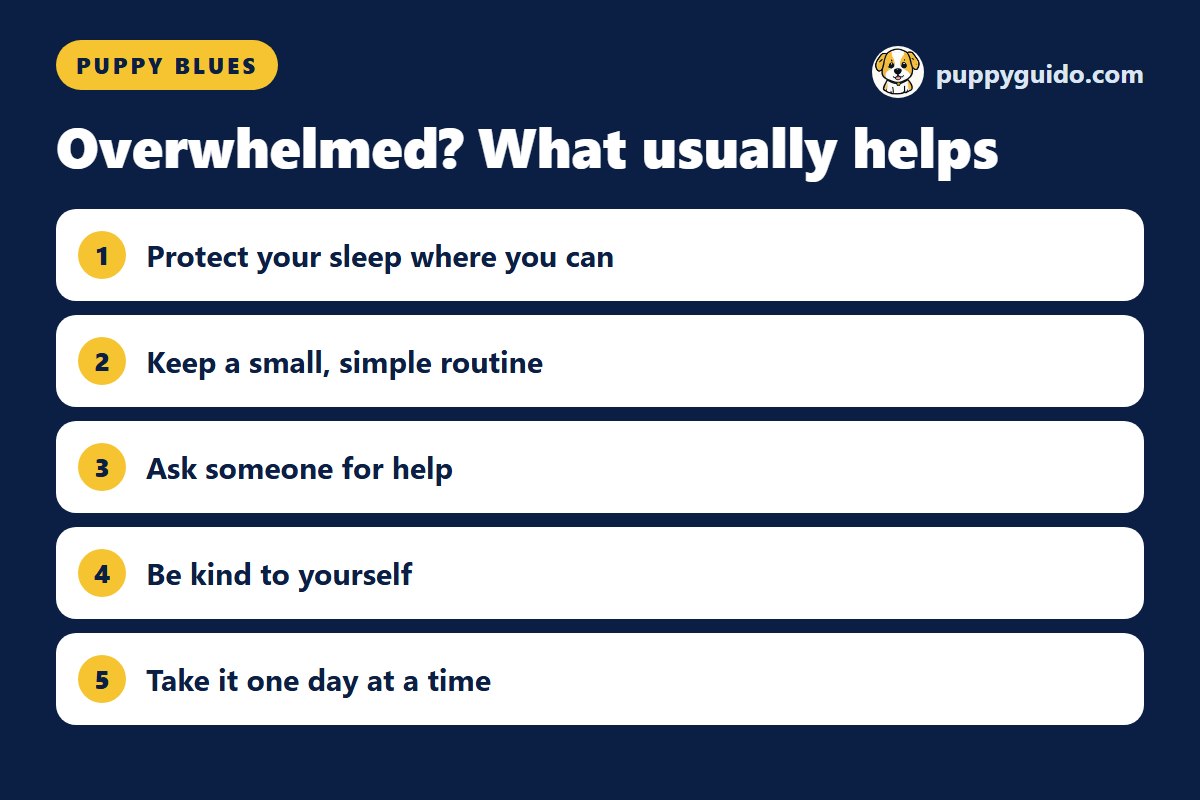
What usually helps
None of these steps will fix everything in a day. Small changes tend to help most.
- Lower the bar for now. The first weeks are for survival and routine, not perfection. A spotless house and a perfectly trained puppy are not the goal yet.
- Pick one routine and repeat it. Meals, outings, naps and bedtime at roughly the same times make a puppy more predictable. A predictable puppy is easier to live with.
- Protect your sleep where you can. If someone else lives with you, take turns with the night shift. If you are on your own, ask a friend or family member to cover one morning so you can rest.
- Plan breaks. Use a safe space such as a crate or playpen so your puppy rests while you step away for a few minutes. Puppies need many naps, and so do you.
- Use one trusted source of advice. Your veterinarian, a qualified positive-reinforcement trainer, or a puppy class is better than scrolling through ten opinions.
- Tell someone how you feel. Saying “this is harder than I expected” to a friend, or to other puppy owners, often makes it feel lighter.
A simple first-week plan to feel more in control
If you are overwhelmed right now, try this for seven days before judging how things are going:
- Write down a daily rhythm with set meal, outing, nap and bedtime slots.
- Take your puppy out after waking, after eating and after play, and reward calmly when they go outside.
- Offer a chew toy when the biting starts, and give yourself a short pause when it gets too much.
- Book a first veterinary visit if you have not already, and bring your questions.
- Choose one thing to improve each day, not ten.
Our free New Puppy Survival Guide includes checklists, routines and a 14-day plan if you want the whole structure in one place.
Want a calm, step-by-step plan? Our 30-day guide, The Puppy Blues Rescue Plan, includes printable trackers for sleep, potty and your own weekly check-in ($9, instant PDF).
How long do the puppy blues last?
There is no fixed timeline, and it is different for every person. The Canadian Kennel Club describes the puppy blues as usually temporary, often lasting around two to three weeks. Other puppy-care writers describe the hardest stretch as the first few weeks, with the feelings easing over the following weeks or months as routines settle and your puppy matures.
The steps above are what usually helps in the meantime. If the feelings stay heavy after several weeks, or they get worse instead of easing, treat that as a signal to ask for support rather than something to push through.
When to ask for more help
Puppy blues usually ease as your puppy grows and your routine settles. Reach out to a professional if:
- The low mood, hopelessness or anxiety lasts for weeks and does not improve, or begins to affect your work, relationships or daily life.
- You have thoughts of harming yourself. In that case, contact local emergency services or a crisis line in your country right away.
- You feel unsafe around your puppy or are worried you might hurt it. Ask a veterinarian or qualified trainer for urgent guidance.
- Your puppy has behavior that worries you, such as aggression, severe fear or signs of illness. Talk to your veterinarian first.
A doctor or a mental health professional can help with the way you feel. A veterinarian or qualified trainer can help with the puppy. Asking for help is a sign you take both seriously.
Is it normal to wonder if you made a mistake?
Yes. Many people have that thought in the hardest weeks, and it does not make you a bad owner. For most people the feeling passes as sleep returns and the puppy learns the routine. If it does not pass, or if you truly cannot give your puppy a safe home, talk with your veterinarian, the breeder or shelter you got your puppy from, or a local rescue about the options. Making that call thoughtfully is better than staying silent.
Source: Ståhl A, Salonen M, Hakanen E, Mikkola S, Sulkama S, Lahti J, Lohi H. “Development and validation of the puppy blues scale measuring temporary affective disturbance resembling baby blues.” npj Mental Health Research (2024), DOI 10.1038/s44184-024-00072-z. This article is general information and does not replace advice from a veterinarian, a trainer or a mental health professional.
Frequently asked questions
How long do the puppy blues last?
There is no fixed timeline. The Canadian Kennel Club describes the puppy blues as usually temporary, often lasting two to three weeks, and for many people the feelings ease over the first few weeks or months as routines settle. If they stay heavy or get worse, talk to your doctor or a mental health professional.
Is it normal to regret getting a puppy?
Yes, doubt and regret in the first weeks are common, and they do not make you a bad owner. Rest where you can, keep a small daily routine and ask someone to take a shift. These feelings often ease as your puppy settles and you both learn the rhythm.
When should I ask for help with the puppy blues?
If low mood, hopelessness or anxiety lasts for weeks without improving, or starts to affect your work, relationships or daily life, speak to your doctor or a mental health professional. For puppy behavior problems, a qualified trainer or your vet can help.
Disclaimer. PuppyGuido provides general educational information and does not replace advice from a qualified veterinarian or professional trainer.
Keep reading
Puppy Harness or Collar? A Simple Guide for New Owners
Collar or harness? Here is how to choose for comfort, ID tags, walks, and the growth spurts that make sizing tricky.
Read articlePuppy Playpen: Do You Need One and How to Use It
A puppy playpen can be a safe, short-term play space, as long as you use it with care and never as long-term confinement.
Read article
First Week With Puppy: What to Do Day by Day
Your puppy is home and you are not sure what comes next, so here is a calm, practical plan for the first seven days.
Read article