
A Realistic Puppy Schedule When You Work Full Time
A Realistic Puppy Schedule When You Work Full Time
Heads up. Some links in this article are affiliate links. If you buy through them we may earn a commission at no extra cost to you. As an Amazon Associate we earn from qualifying purchases.
The reality of the working puppy parent
You are standing in your kitchen at 6:30 AM, nursing a lukewarm cup of coffee while a small, furry whirlwind latches onto your pajama pants. You have a meeting at 9:00 AM, a commute that takes forty minutes, and a puppy who has already decided that your favorite slippers are the finest delicacy in the house. Finding a manageable puppy schedule when working full time feels like a puzzle with missing pieces. We have all been there, staring at the clock and wondering how on earth we are going to balance a career with the needs of a creature that has the bladder of a hummingbird and the energy of a lightning bolt.
The truth is that raising a puppy while working a traditional job is difficult, but it is not impossible. It requires a shift in perspective. You are not just fitting a dog into your life; you are building a structure that supports their development while you are away. Every puppy is different, and some will settle into a routine faster than others. The goal is to create a predictable environment where they feel safe, even when you are not in the room. This starts with a solid morning routine and ends with a dedicated evening of connection, with a very important bridge in the middle of the day.
Building your morning foundation
Your workday does not start when you clock in; it starts the moment the puppy wakes up. When you are managing a puppy schedule, the morning hours are your most valuable tool for setting the tone of the day. If you can tire them out mentally and physically before you leave, they are much more likely to sleep through the first few hours of your absence. This usually means waking up an hour earlier than you used to. It is a sacrifice, but it prevents a lot of stress later on.
The first thing on the agenda is always a trip outside. Before you even think about breakfast, get them to their designated potty spot. Once they have finished, you can move on to a bit of play and training. Ten minutes of practicing basic cues like sit or touch can be more exhausting for a puppy than a long walk. After they have burned some energy, offer them breakfast. Many working owners find that using a puzzle feeder or a slow-bowl for breakfast helps keep the puppy occupied while you are getting dressed for work. This is a great time to ensure they are following their potty schedule by age, as they will almost certainly need to go again shortly after eating.
The pre-departure ritual
As you get ready to leave, try to keep things calm. If you make a big fuss about saying goodbye, you might inadvertently trigger anxiety. Instead, about fifteen minutes before you walk out the door, start transitioning them to their safe space. This might be a crate or a playpen. Give them a high-value chew or a stuffed toy that they only get when you are away. This creates a positive association with your departure. By the time you are picking up your keys, they should be focused on their treat rather than your exit. If you are still in the early stages of getting them used to their den, you might want to review some tips on crate training to make this transition smoother. For how rest fits between those trips, see the puppy nap and sleep schedule.
The midday break is non-negotiable
One of the hardest parts of potty training puppy when working full time is the physical limitation of a young dog. A puppy’s bladder capacity is tiny. Sources vary. AKC and VCA suggest roughly one hour per month of age, while Humane World for Animals gives age in months plus one hour for crating. Treat these as upper limits, not goals. By the stricter figures, a two-month-old puppy is pushing their luck after two hours. If you are gone for eight or nine hours, expecting them to wait is not only unrealistic but can also lead to long-term house-training issues and physical discomfort. For the numbers from each source, see can you leave a puppy alone for 8 hours.
You must arrange for a midday break. If you live close enough to work to head home for lunch, that is ideal. If not, this is where you call in reinforcements. A professional dog walker, a trusted neighbor, or a local teenager can be a lifesaver. This person should not just let the puppy out to pee; they should provide fifteen to twenty minutes of social interaction and perhaps a small snack or fresh water. This break divides the day into manageable chunks, preventing the puppy from feeling isolated and reducing the chance of accidents in their safe area.
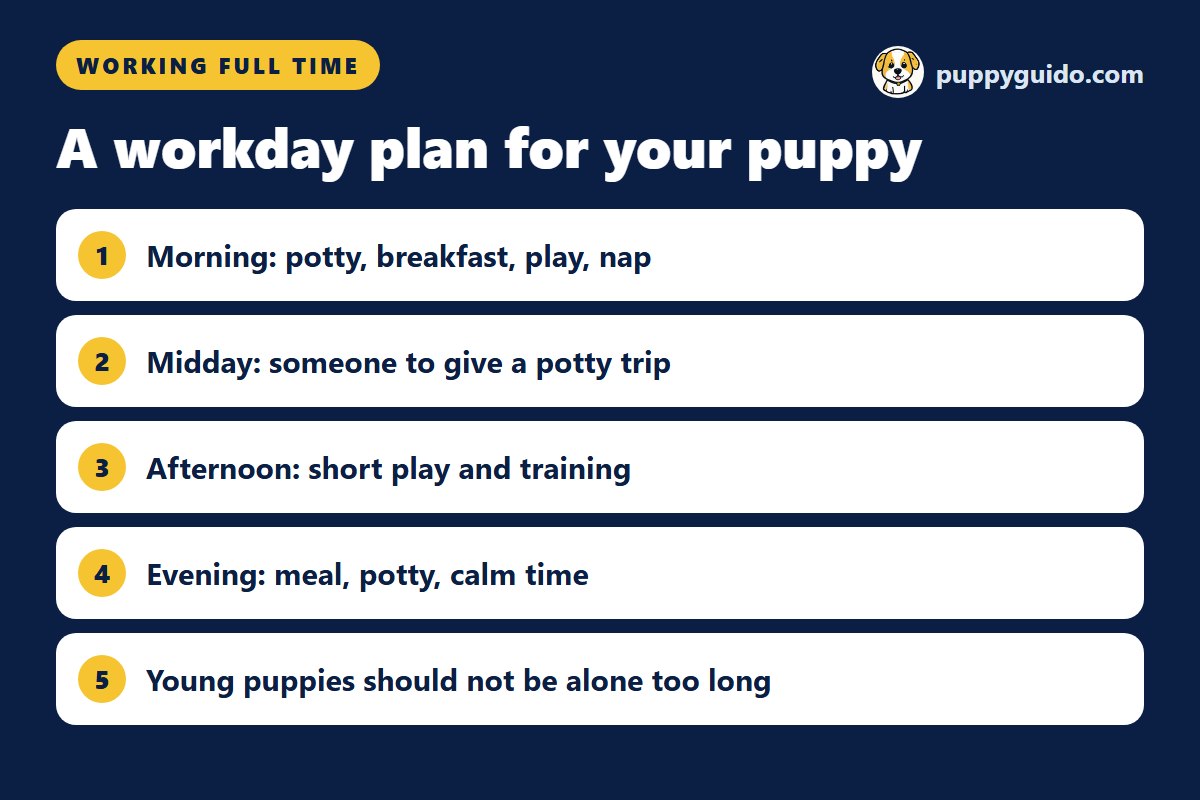
A sample puppy schedule example
Having a visual guide can help you map out your day. While this puppy schedule example is a great starting point, remember to adjust it based on your specific commute and your puppy’s individual needs. Some puppies are naturally more lethargic in the mornings, while others are ready to go at dawn.
| Time | Activity | Goal |
|---|---|---|
| 6:30 AM | Wake up and immediate potty trip | Empty bladder |
| 6:45 AM | Playtime and light training | Mental stimulation |
| 7:15 AM | Breakfast in a puzzle toy | Slow feeding and engagement |
| 7:45 AM | Final potty trip and settle down | Preparation for departure |
| 8:00 AM | Departure to work | Puppy in safe space with a chew |
| 12:00 PM | Midday visit (Walker or Owner) | Potty, water, and social time |
| 12:30 PM | Return to safe space | Afternoon nap |
| 4:30 PM | Owner arrives home and potty trip | Immediate relief and greeting |
| 5:00 PM | Evening walk or play session | Physical exercise |
| 6:30 PM | Dinner time | Nutrition |
| 8:00 PM | Calm bonding and grooming | Winding down |
| 10:00 PM | Final potty trip and bedtime | Sleep through the night |
Creating a safe space for the day
Leaving a puppy to roam the house while you are at work is a recipe for a chewed-up sofa and a very stressed dog. You need a setup that balances safety with comfort. For very young puppies, a playpen is often better than a crate if you are gone for more than four hours. You can place the crate inside the playpen with the door open, providing a cozy bed, and then lay down some puppy pads in a far corner of the pen for emergencies. This is a realistic approach to potty training puppy when working full time because it acknowledges that accidents might happen when they are very young.
Make sure the area is completely puppy-proofed. Remove any electrical cords, house plants, or small objects they could swallow. If you are using a specific room, like a laundry room or kitchen, use baby gates to keep them contained. Check the temperature of the room to ensure it stays cool in the summer and warm in the winter. Leaving a radio on at a low volume can also help drown out street noises that might cause a puppy to bark or feel on edge. If you are still preparing your home, checking off items on a new puppy checklist can ensure you haven't missed any safety hazards.
Adapting the schedule as they grow
As your puppy matures, their needs and their ability to handle your absence will change. What works for an eight-week-old will not be enough for a six-month-old. You should constantly evaluate your puppy schedule to see if it needs a tweak. Here is how those needs typically evolve over the first few months.
8 to 10 weeks
At this age, the puppy is still a baby. They sleep a lot, but they also need to go out very frequently. Their focus is on feeling secure in their new home. Midday visits are essential, and you might even need two visits if your workday is particularly long. Keep training sessions very short—just two or three minutes at a time.
10 to 12 weeks
You might notice a bit more personality emerging. They are becoming more curious and perhaps a bit more vocal. This is a great time to introduce more complex puzzle toys to keep their brains busy while you are gone. They are still physically incapable of holding their bladder all day, so keep that midday walker on speed dial.
3 to 4 months
By now, the puppy should be getting the hang of the routine. They might start sleeping more reliably while you are away. This is often when teething hits its peak, so providing a variety of textures to chew on is vital. You can start slightly increasing the time between potty breaks, but don't push it too far yet.
4 to 6 months
Many puppies can now hold their bladder for longer stretches, and some might even be able to manage a four or five-hour block. However, they are also entering adolescence, which means they might start testing boundaries. Consistency is your best friend during this phase. If they have been doing well, you might consider transitioning from a playpen to a larger puppy-proofed area, but only if they have proven they can be trusted.
Handling the evening witching hour
When you walk through the door after a long day at the office, you probably want to sit on the couch and relax. Your puppy, however, has been waiting for this moment all day. They have a reservoir of pent-up energy that is about to explode. This is often called the witching hour, where puppies might zoom around the house, nip at your heels, or bark for attention. It is helpful to understand how to stop puppy biting during these high-energy moments, as over-tired or over-excited puppies often use their mouths to communicate.
Instead of getting frustrated, lean into it. This is your primary bonding time. Take them for a walk, play a game of tug, or do some training in the backyard. Once they have had a chance to move their bodies and use their brains, they will be much more likely to settle down for the evening. Our guide to puppy zoomies explains why evenings get wild. The goal is to make the time you are home so enriching that they are happy to rest while you are away. If you find yourself feeling overwhelmed or regretting the decision to get a dog during these hectic evenings, know that puppy blues are a very real and common experience for new owners.
When to ask a professional
There are times when even the best schedule doesn't seem to work. If your puppy is showing signs of extreme distress when you leave, such as non-stop howling, destructive behavior directed at exit points, or refusing to eat treats while you are gone, they may be experiencing separation anxiety. In these cases, it is best to consult a professional positive-reinforcement trainer or a veterinary behaviorist. They can help you create a desensitization plan. Additionally, if your puppy has frequent accidents despite a solid schedule, or if you notice changes in their thirst or energy levels, a quick call to your veterinarian is always the right move to rule out any underlying health issues.
Consistency is the key to success
Setting up a puppy schedule when working full time is a marathon, not a sprint. There will be days when you come home to a shredded roll of paper towels or a puddle on the floor. It happens to the best of us. The key is to stay consistent with the routine. Puppies thrive on predictability. When they know exactly when they will be fed, when they will play, and when they will see you again, their anxiety levels drop, and their behavior improves.
- Establish a firm wake-up time and stick to it even on weekends.
- Secure a reliable midday helper before the puppy arrives home.
- Prepare all puzzle toys and meals the night before to save time.
- Use a camera to monitor your puppy's behavior while you are away.
- Keep your departures and arrivals low-key to prevent over-excitement.
As the weeks turn into months, you will find that the whirlwind starts to slow down. The 6:30 AM wake-up calls become a little less frantic, and the slippers stay on your feet instead of in the puppy's mouth. You are building a relationship that will last for years, and the effort you put into these early days will pay off in a well-adjusted, happy adult dog who fits perfectly into your life. Take it one day at a time, be patient with yourself and your pup, and don't forget to enjoy those quiet moments of puppy breath and sleepy cuddles when the workday is finally over.
Get the free New Puppy Survival Guide
Frequently asked questions
How long can a puppy be left alone while I am at work?
A general rule is that puppies can hold their bladder for one hour for every month of age. An eight-week-old puppy should not be left for more than two hours. If you work an eight-hour day, you must arrange for someone to visit at least once or twice to let them out.
Is it possible to potty train a puppy if I work all day?
Yes, it is possible, but it requires a very consistent morning and evening routine. You will also need a midday helper to ensure the puppy does not have accidents in their crate. Using a playpen with a designated potty area can also help if you cannot get home.
Should I use a crate or a playpen when I am at work?
For short periods, a crate is excellent for potty training. However, if you are gone for more than four hours, a playpen or a puppy-proofed room is better. This allows the puppy to move around, stretch, and have access to water without being confined in a small space for too long.
How can I keep my puppy entertained while I am at the office?
Provide safe, durable chew toys and puzzle feeders like stuffed rubber toys. These keep their minds busy and help soothe teething discomfort. You can also leave a radio or white noise machine on to mask outside sounds that might cause the puppy to bark or feel anxious.
What should I do if my puppy has an accident while I am away?
Never punish a puppy for an accident you did not witness. Simply clean it up with an enzymatic cleaner to remove the scent. If accidents happen frequently, it is a sign the puppy is being left too long or the safe space is too large, and you may need more frequent midday visits.
Disclaimer. PuppyGuido provides general educational information and does not replace advice from a qualified veterinarian or professional trainer.
Keep reading

First Commands to Teach a Puppy: 5 Cues to Start With
Name, sit, down, come and leave it: five first cues to teach your puppy, with simple steps and short, reward-based sessions.
Read article
Puppy Socialization Checklist: What to Introduce and How to Do It Safely
What to introduce your puppy to, before and after vaccines, and how to keep it calm, from veterinary behaviorists and Dogs Trust.
Read articlePuppy Slow Feeder Bowls: Are They Worth It?
A calm, practical look at whether a slow feeder bowl suits your new puppy, and how to use one without the mealtime drama.
Read article